J.A. Rogers and Queen Charlotte Sophia: Let Us Not Forget History
Updated: Sep 18
j a rogers_edited Charlotte_Sophia_of_Mecklenburg-Strelitz_by_studio_of_Allan_Ramsay
"…no man living has revealed as many important facts about the Negro race as has Rogers." - W.E.B. DuBois
I felt compelled to write this blog post after watching the news and reading insightful articles online about the engagement of Prince Harry from the British Royal Family to Meghan Markle, a Black American actress. Online forums were filled with reactions ranging from joy to indifference and even hate speech. The hope that the election of America's first Black President would usher in a racial utopia was unfortunately met with a harsh reality. What followed was the calculated racism orchestrated by Steve Bannon, leading to Donald Trump's election, the rise of the Alt-Right, Muslim bans, the dismantling of DACA, and criticism of African-American NFL players for exercising their First Amendment rights. The anticipated post-racial era during Obama's presidency never materialized; instead, it highlighted that we still live in a deeply racist society. Thus, the news of a Black American joining the predominantly white "blue blood" British Royal Family understandably attracted significant attention.


The Washington Post recently published an article noting that this is not the first instance of a Black woman marrying into the British Royal Family. Queen Charlotte Sophia, the wife of King George III, was also believed to have Black ancestry. This is the same Charlotte after whom Charlotte, North Carolina, is named, and also the same Queen Charlotte after whom Charlottesville, Virginia, is named. Charlottesville is famously known for the disturbing display of hate when Neo-Nazi Fascists of the Alt-Right marched through to protest the removal of Confederate statues in public spaces. It's ironic to consider that they marched for white nationalism in a town named after a Black queen. Queen Charlotte's contemporaries referred to her as a "mulatto." Her portraits, especially those by Sir Allan Ramsay, depict her as a mixed woman, evidently of African descent, or a woman of color. According to outdated but persistent American standards, someone of mixed heritage is considered Black under the one-drop rule. For instance, President Barack Obama, born from an interracial marriage, is recognized as the first Black President. Similarly, celebrities like Alicia Keys and Halle Berry are identified as Black. By this definition, both Queen Charlotte Sophia and Meghan Markle would be considered Black women.

Both a Washington Post article by DeNeen Brown and an insightful 2009 piece in The Guardian by Stuart Jefferies shed light on the lesser-known African heritage of the British Royal Family. However, the primary credit for uncovering this hidden black history goes to historian Mario De Valdes y Cocom. He expertly traced Queen Charlotte's African lineage to a Moorish noble family that once ruled the Portuguese town of Faro, which was later conquered by Alfonso III of Portugal. Alfonso had children with the daughter of the defeated Moorish governor, and their child, Martin Alfonso, married into the noble de Sousa family. The notion of a Black Queen Charlotte is remarkable, as it suggests that African ancestry is present in Queen Victoria, Queen Elizabeth II, and even Prince Harry. This revelation challenges the conventional idea of black inferiority by introducing the concept of white nobility with African roots.
All of these articles and documentaries are fascinating, but I was surprised that no one mentioned Harlem Renaissance writer Joel Augustus Rogers, fondly known as J.A. Rogers. It was Rogers, even before Mario De Valdes y Cocom, who first asserted that Queen Charlotte Sophia was Black. Rogers made these claims as early as the 1940s in his three-volume book series "Sex and Race." He also discussed Charlotte's Black ancestry again in his book "Nature Knows No Color Line."

He even featured a picture of Queen Charlotte on the book's cover. Rogers was somewhat bewildered by the notion of racism, as he believed that a pure race didn't exist. The purpose of many of his books, along with their provocative titles such as "Sex and Race," was to demonstrate that various groups have been intermingling for so long that the concept of purity is absurd.

Rogers was unaware at the time of his writing just how accurate he was, as both contemporary anthropologists and geneticists working with DNA would later confirm that the notion of race is entirely unscientific. Rogers' interest in race likely stemmed from his background as the child of mixed-race Jamaican parents. Upon immigrating to America, he experienced firsthand how racism was employed as a political tool to exclude black people from well-paying jobs and hinder their social advancement. When Rogers applied to the University of Chicago, he was denied admission. Unable to secure meaningful employment, he took a job as a Pullman Porter, serving white passengers on trains. This position, however, provided him with the opportunity to travel across the country by rail, enabling him to conduct research in libraries. The challenge was that racism barred Black individuals from entering libraries through the front door. Rogers circumvented this obstacle by paying a white colleague to enter the library and borrow books for him. Though the white colleague thought Rogers was misguided, Rogers knew otherwise.
With the knowledge Rogers accumulated, he became akin to a black Robert Ripley, uncovering numerous facts about black history. He went on to author several books and took on roles with various black newspapers of the era, including the Pittsburgh Courier, New York's Amsterdam News, and Marcus Garvey's Negro World. Rogers penned his own column in the Pittsburgh Courier titled "Your History." One of his notable small books was titled 100 Amazing Facts About The Negro.

Rogers captivated his audiences with the histories shared in his books about the unknown Black Pharaohs, the Black Jews of Ethiopia, and the African ancestry of figures like Beethoven, Queen Charlotte Sophia, and even some American Presidents. He authored a book titled The Five Negro Presidents, challenging the notion that Obama was the first. Rogers ingeniously reversed racism; if the one-drop rule was used to exclude blacks from power due to supposedly inferior blood, he used the same logic to claim those individuals as Black. By applying America's own criteria for blackness, Rogers effectively made a compelling argument for many of his assertions. By using their own arguments, Rogers essentially turned the intellectual weapon back on his oppressors.

Rogers and his numerous books became a staple in many black barbershops and on the coffee tables of black households, sitting alongside Ebony and Jet magazines. He is one of the rare figures in Black American History who bridges various personalities with differing viewpoints and philosophies. Black nationalists like Marcus Garvey, Elijah Muhammad, Malcolm X, and John Henrik Clarke all read and respected Rogers, as did more moderate and conservative voices like W.E.B. Du Bois and Harvard professor Henry Louis Gates. It would be an oversight not to recognize Rogers when discussing Queen Charlotte's African ancestry, as he was likely among the first to mention this fact. It seems more than coincidental that historian Mario De Valdes y Cocom first heard about the rumors of Black Queen Charlotte from his Jamaican nanny Etheralda "TeeTee" Cole. Coincidentally, Rogers is also Jamaican, and perhaps she was reading a copy of "Sex and Race" or "Nature Knows No Color Line."
It is worth noting that J.A. Rogers's interest in royalty extended beyond the British Royal Family. He was also knowledgeable about numerous African Kings and Queens. While working for the Pittsburgh Courier, Rogers reported on the coronation of Ethiopian Emperor Haile Selassie, who claimed a more distinguished royal lineage than the British monarchy. Selassie asserted that he was the 225th direct descendant of the Ethiopian Queen Sheba and the Jewish King Solomon. Ethiopia is often referred to as Africa's Holy Land, having embraced Christianity, Judaism, and Islam at an early stage. It was home to these three monotheistic religions long before many Northern European nations, which at that time were either still worshipping sacred groves like the Druids in the British Isles or venerating Norse gods such as Thor, Odin, and Loki in Germany and Scandinavia.

Today, we might find ourselves captivated by the Western media's focus on the British Royal Family, often overlooking the fact that before European colonialism, kingship and queenship were as significant in Africa as they were in Europe. It is likely that the origins of monarchy and divine kingship trace back to Africa long before Europe's first kings and queens. J.A. Rogers shed light on this often-overlooked African royalty, ranging from the Pharaohs of Egypt and the Queen Candaces of Nubia to the Ras of Ethiopia and the Mansas of Mali.
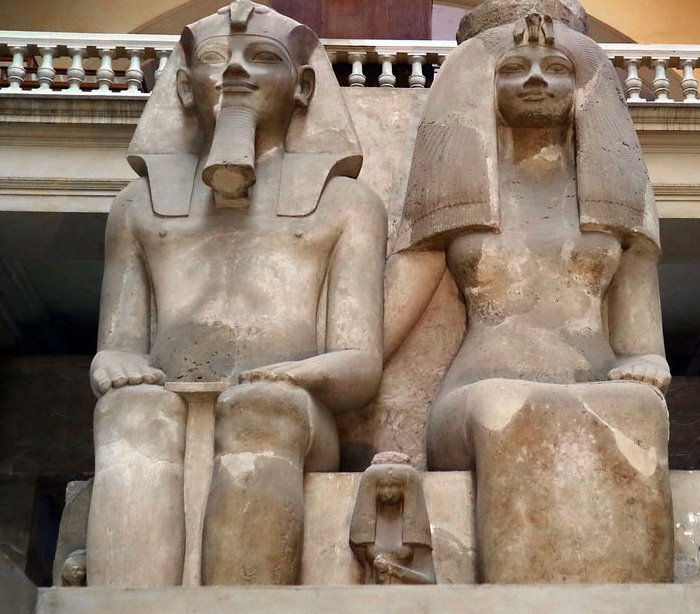
Pharaoh Amenhotep III and Queen Tiye

Mansa Musa King of Mali

Queen Nzinga of Angola

Nubian Pharoahs of the 25th Dynasty
Further Reading:
J. A. Rogers. Nature Knows No Color-Line: Research into the Negro Ancestry in the White Race. New York. 1952.
J.A. Rogers. Sex and Race: Negro-Caucasian Mixing in All Ages and All Lands, Volume I: The Old World. New York. 1940.
Comments