Before Easter: The Spring Equinox, Megaliths, Fertility Cults, and Rebirth
Updated: Sep 18

Despite the East Coast weather not reflecting it, as we experience one nor'easter after another, Spring is indeed here. Apart from the bothersome allergies, Spring is a time of celebration for many. For most Christians, Spring brings the celebration of Easter, marking the resurrection of Christ. Before Easter, many of the Jewish faith observe Passover. In Judaism, Passover derives its name and meaning from the Hebrew God, who sent the Angel of Death to "pass over" Hebrew doorposts marked with lamb's blood. Egyptian doorposts not marked with lamb's blood did not receive mercy, leading to the death of the firstborn child in each Egyptian home. The severe plagues sent by God upon the Egyptians compelled them to free Moses and his people from slavery in Egypt. For Jews worldwide, Passover is a ritual and celebration that commemorates their liberation from bondage in Egypt.

James J. Tissot's "The Egyptians Are Destroyed" 1896-1902
This article aims to explore whether people in ancient times had "Spring Celebrations" before our modern interpretations of Easter and Passover, and if they did, what were these celebrations called? Who participated in them, and more importantly, what elements from these ancient traditions do we still observe today without realizing it? Although Christianity and Judaism are often seen as ancient religions, they are not as old as some might think. Many people don't consider the world that existed before these relatively old faiths, but such an ancient world did exist. This ancient world was highly advanced and connected with nature and the universe. It was a world that contributed mathematics, medicine, architecture, and laid the foundational seeds for world religions. However, it has often been overlooked and not studied because it was labeled as "pagan." Today, the word pagan carries a negative connotation, but by studying these pagan civilizations, we begin to unravel mysteries and gain a deeper understanding of the world around us.

Rabbits, hares, and eggs have nothing to do with Christianity
what then is the origin of these contradictory symbols?
Much of the candy found in an Easter basket can be perplexing and has little to do with Christ. As a child, I recall that on Easter, many of us would partake in the tradition of eating chocolate Easter bunnies, breaking open Easter eggs filled with jelly beans, and skipping over what many consider the unappealing (though I personally liked it) Peeps yellow chick candy. In truth, these symbols don't make much sense unless one is aware of the older pagan civilizations that provide these symbols with their pertinent meaning.


Does the Easter Bunny's origin lie in the enigmatic tales of the German goddess Eostre, who is often symbolically linked to the hare, or does it trace back even further to the Babylonian goddess Ishtar? Due to their large litters, rabbits and hares are universally recognized as symbols of life and fertility.
Spring is the season when everything turns green as daylight increases, but how did the rabbit become linked to equinoxes and Spring? What's the relationship? Many historians specializing in esoterica suggest that the rabbit, or hare, was an ancient German fertility symbol connected to life due to their reputation for sexual vitality and large litters, with up to 14 babies (kits) in one litter. Rabbits are also known for giving birth in the Spring. If the Spring Equinox signifies new life, then a rabbit or hare is an ideal symbol.
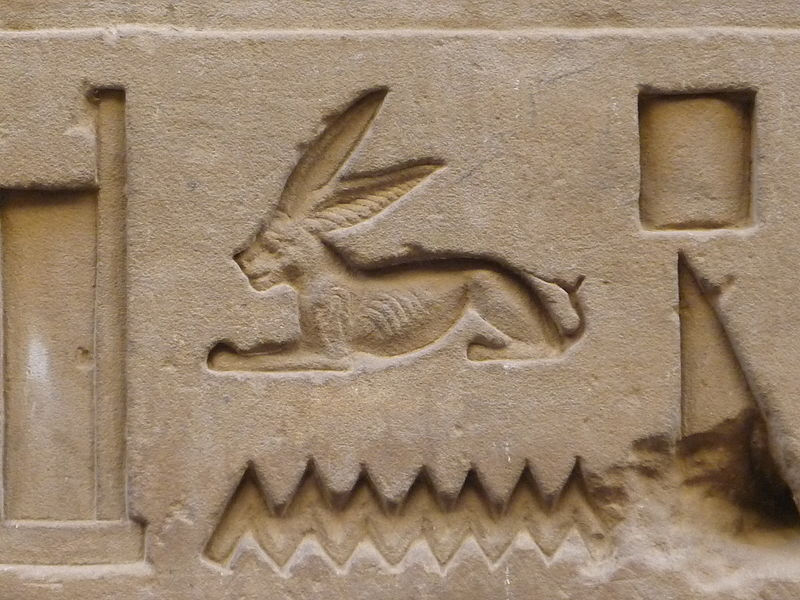
Some suggest that the name Easter originates from the German goddess of fertility, Eostre. Similarly, the Egyptians had a rabbit deity named Wenet/Wenut/Wenenu, sometimes linked with the female goddess, and at other times with the male god Osiris. Known for resurrection and life, Osiris was a fertility god, making the association with the hare fitting. The egg is a clear symbol of fertility, as it is fundamentally the foundation of life. While rabbits don't lay eggs, they stand alone as a fertility symbol. Some believe that the egg as a fertility symbol dates back to the Babylonian fertility goddess Ishtar. Notably, the pronunciation of Ishtar resembled "Easter." Like the Egyptian sun-god Ra/Horus, the Babylonian Ishtar was born from an egg. I recall a lecture by historian Dr. Charles Finch of Morehouse College, where he noted that the yellow chick represents the Egyptian sun-gods Horus and Ra, who were born from a golden egg, becoming the golden falcon sun-god linked with the winter solstice and possibly the Spring Equinox. For the Egyptians, the yolk of an egg symbolized the sun, which was associated with the falcon that soared high and observed everything. The god Horus was both a sun god and a falcon god.


Could the Egyptian God Horus be the inspiration for the yellow chick, given that yellow is the color linked to both an egg's yolk and the sun?
Many historians of esoterica find the timing of both Easter and the Jewish Passover intriguing. These dates align with the much older pagan celebration of the Vernal Equinox, or Spring Equinox. One might wonder why these holidays are scheduled on or around the Spring Equinox. In fact, Easter Sunday is not fixed; it is always the first Sunday following the first full moon after the Spring Equinox. Before the advent of Judaism, Christianity, or Islam, the Spring Equinox was celebrated by many civilizations worldwide because, for pagans, it symbolized a celebration of life. The Spring Equinox marked the end of winter and darkness and the return of light. The word 'equinox' translates to 'equal.' The Equinox is a day of equal light and darkness. Before the Spring Equinox, the days are noticeably shorter, dominated by darkness. On the Equinox, many observe that the days are becoming noticeably longer, which would occur naturally regardless of daylight saving time.

At the equinox, the sun aligns with the equator, resulting in equal amounts of light and darkness. Following the equinox, the sun begins to outshine the darkness, leading to increasingly longer days. This is a natural occurrence. The ancients were more attuned to nature than we are today, unaffected by man-made "daylight savings time" and artificial electric lighting.
What holds even greater significance is that the day after the Equinox, light starts to prevail over darkness, with days gradually becoming brighter until they reach their peak at the Summer Solstice. Esoteric historians have noted an intriguing coincidence: the Jewish "Passover" is celebrated around the same time as the ancient celebrations of the Spring Equinox, although the pagan observance of the Equinox predates the Jewish tradition. The ancients marked the sun "passing over" the equator, heralding the arrival of Spring and, consequently, life. These early civilizations were skilled astronomers deeply attuned to nature and the movements of the sun, stars, and planets. They understood that a thorough knowledge of nature enabled them to better manage their lives, whether in planting crops or navigating the seas. Easter baskets are often filled with green grass. Could this symbolize the emergence of green flora and newborn fauna following the Vernal, or Spring, Equinox?

Ancient pagan civilizations celebrated the Vernal Equinox as it signaled the onset of Spring and the renewal of life. Did the Roman Catholic Church intentionally align the dates of Easter with these much older sacred pagan dates, and if so, why?
Many have claimed that the Roman Catholic Church certainly integrated older pagan traditions, such as the Vernal Equinox, into Christianity to facilitate the conversion of pagans and the spread of the Christian faith. Others have noted that the Jewish faith, similar to Christianity, also incorporated elements from the pagan world, particularly drawing heavily from ancient Egyptian religion. As mentioned in a previous post, the Jewish concept of monotheism was shown to have existed under the Egyptian Pharaoh Akhenaton, and the tradition of not eating pork was an earlier Egyptian custom linked to the Egyptian God Set. Circumcision, a ritual long associated with a covenant with Abraham, appears to have originated in Egypt, with evidence carved on temple walls. The timing of Passover on an older, already established pagan date of the Spring Equinox further demonstrates how all religions eventually blend into one another.

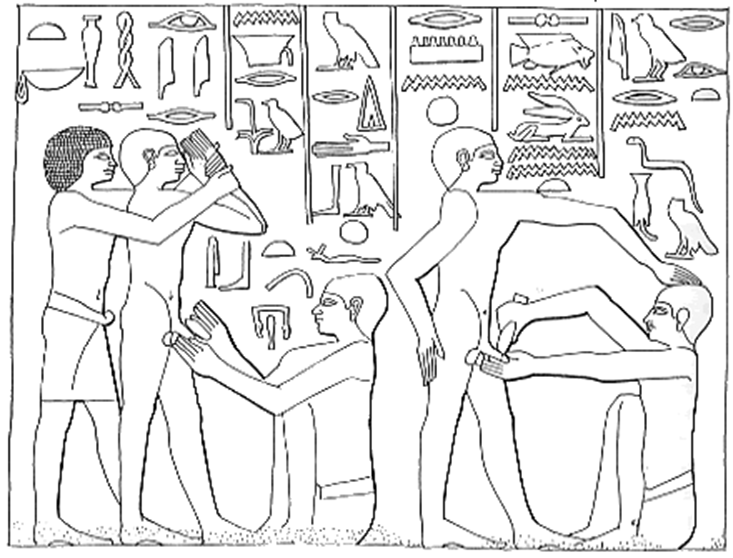
Monotheism, abstaining from pork, circumcision, and the celebration of the Vernal Equinox appear to have been documented initially in Egypt prior to the emergence of Judaism. This bas-relief originates from Saqqara and is over 4,000 years old.
The final point I want to discuss is how ancient civilizations incorporated their celebration of the Spring Equinox into their architecture, a practice that many scientists today refer to as the lost art of archaeoastronomy. When discussing the Spring Equinox, it is essential to mention Stonehenge, the renowned megalithic structure in England. While Stonehenge is not the only stone circle in England aligned with the sun, it is the most well-known. Constructed around 5000 years ago, circa 2500 B.C., the builders of Stonehenge remain unknown. However, it was later used by the Druid priest class and, like many ancient structures, was aligned with the sun, specifically during the solstices rather than the equinox. The largest stone circle in England, Avebury, is believed by some scholars to be aligned with the equinox. Even today, followers of the ancient Druid religion make pilgrimages to both Avebury and Stonehenge to celebrate the equinoxes and solstices. The Spring Equinox and Summer Solstice share similar meanings, both being associated with life.
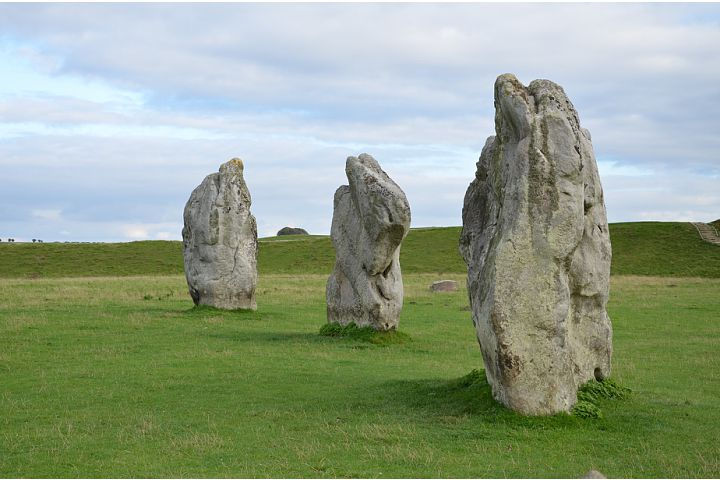
The Avebury stone circle is the largest megalithic stone circle in England and is aligned with the sun during the Spring Equinox.

England is home to numerous megalithic stone circles, such as Avebury and Stonehenge. These structures marked the solstices and equinoxes thousands of years before the establishment of dates for Easter, Passover, and Christmas.
President Obama visited Stonehenge in 2014 inquires about the path of the solstices and equinoxes.
On the Mediterranean island of Malta, one of the world's oldest temples, the Mnajdra Temple, can be found. Constructed as early as 3,600 BC, it was aligned with the Spring Equinox. Interestingly, many people believe that the temples of Malta are shaped like a woman. This symbolism suggests that sunlight entering the female temple during the Spring Equinox signifies the bringing of life. Much like the equinox and springtime, women were revered as symbols of life and fertility.

The Mnajdra Temple at Malta illuminated during the Spring Equinox.
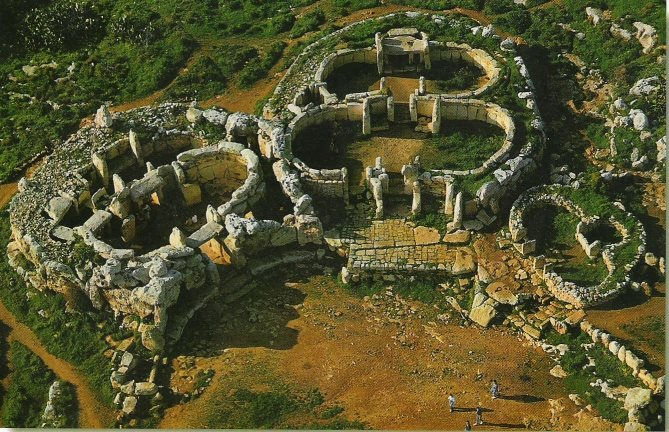
Researchers suggest that the Mnajdra Temple in Malta was designed to resemble a woman. The Spring Equinox and women were both considered symbols of fertility. Symbolically, the sun's light (a masculine fertility symbol) would impregnate the temple. Temples and churches have traditionally been seen as feminine, which explains why numerous Gothic cathedrals are dedicated to Notre Dame (Our Lady).
The Egyptian civilization was frequently lauded in ancient Greek texts as the source of ancient world knowledge. Notably, Alexander the Great chose to be buried in Egypt rather than Macedonia or Greece, which is quite significant. The greatest library of the ancient world, the Library of Alexandria, was also situated in Egypt. Therefore, it is not surprising that the Egyptians uniquely aligned their structures with celestial bodies. The Temple of Karnak is aligned with the Winter Solstice, as are many other Egyptian structures. The Great Pyramid is positioned at the Earth's center, aligned with the four cardinal points: North, South, East, and West. During the Spring Equinox, when the sun is directly over the equator, marking the Great Pyramid at 30 degrees North and using the equator as a midpoint to 30 degrees South creates a pyramid shape pointing directly toward the equinoctial sun above. This image is too precise to be coincidental and strikingly resembles the unfinished pyramid on the back of the dollar bill, with what seems to be a sun blazing behind the eye.

The depiction and positioning of the Great Pyramid, along with its alignment with the sun during the Spring Equinox, show a triangular shape when placed at 30 degrees North and South. This configuration closely resembles the image seen on the Great Seal of the Dollar Bill.

The Great Pyramid isn't the only Egyptian monument aligned with the Spring Equinox; the enigmatic Sphinx also shares this alignment. Although little is definitively known about the Sphinx, intriguing discussions continue about whether it once represented Anubis or Leo. What is certain is that during the Spring Equinox, the Sphinx faces the sun as it rises over the horizon. In fact, the Sphinx was named "Hormakhet," which translates to Horus or the sun on the Horizon. The exact age of the Sphinx remains unknown, but some theories suggest it predates the Great Pyramids. Astronomical software, capable of determining historical star positions, indicates that as far back as 10,500 BC, the Sphinx was aligned not only with the sun during the Spring Equinox but also with the constellation Leo. This makes sense if the Sphinx has the body of a lion and the head of a man.

The Sphinx in alignment with the sun on the Spring Equinox
England and Egypt were not the only ancient civilizations to observe the Vernal/Spring Equinox. Further south of Egypt, in the Nubian Desert at a place called Nabta Playa, lies what might be one of the oldest megalithic structures in the world, also aligned with the Spring Equinox. The megalith at Nabta Playa dates back approximately 8000 years. The site was researched by Fred Wendorf, an anthropology professor from Southern Methodist University in Texas, and later studied by independent historian Robert Bauval and former NASA physicist Thomas Brophy. It appears that even before Egypt, the African pastoralists at Nabta Playa were aligning their structures with the solstices and equinoxes. Some speculate that these African nomads at Nabta Playa may have eventually settled along the Nile River, becoming the very first Egyptians.

The megastructure at Nabta Playa in the Nubian Desert is also aligned to the Vernal Equinox, and predates both Stonehenge and the Great Pyramid by thousands of years.
The final example of celebrating the Vernal Equinox can be found in Mexico at a site known as Chichen Itza. The temple pyramids there were constructed by the Maya and Toltec civilizations. Although the structures at Chichen Itza are around 1,000 years old, the god Kukulkan was worshipped in the Yucatan as early as 900 B.C. at La Venta, Mexico, among the Olmec civilization. Additionally, Chichen Itza was built over an even older pyramid, which would obviously date it back even further. These temples were dedicated to a god of death and resurrection called Kukulkan, also known as Quetzalcoatl.

Kukulkan was always depicted as a feathered serpent, essentially a serpent with feathers. Kukulkan (Quetzalcoatl) combined the forms of a snake and a bird, an image that still appears on the Mexican flag today. On the day of the Spring Equinox, the temple at Chichen Itza aligns with the sun. In one of the most remarkable examples of masonry, engineering, and archaeoastronomy, as the sun strikes the pyramid, a shadow of the serpent God Kukulkan appears to slither down its side. Much like the megalithic structures at Stonehenge, England, pilgrims gather from all over to witness this incredible demonstration of human ingenuity and the ability of humanity to connect with the universe.

Mayan pyramid at Chichen Itza Mexico dedicated to the plumed serpent God Kukulkan.

During the Spring Equinox the pyramid at Chichen Itza is in alignment with the sun, and at that very moment the shadow of a serpent winds down the side of the structure.
Video of the shadow of the plumed serpent God Kukulkan winding down the side of the pyramid at Chichen Itza during the Spring Equinox.
Apart from the shadow of the Kukulkan snake descending the pyramid's side during the Spring Equinox, the bird chirp produced when one claps at the pyramid's base is equally astonishing. If this is confirmed, the ancients' ingenuity is astounding, as they incorporated Kukulkan's bird and serpent characteristics into the pyramid.
In conclusion, this post is not intended to diminish the significance of the great religions of Judaism and Christianity. Instead, it aims to enhance our understanding of earlier cultures and emphasize the shared elements among all religions, particularly their connection to the Spring Equinox. By concentrating on our similarities rather than our differences, I believe we can reduce the prejudices we might hold against those once considered primitive. We may gradually come to recognize that all peoples have contributed to civilization and that we share more commonalities than we realize. Lastly, I would like to note that the Spring Equinox is powerful because it resonates with everyone, regardless of race, nationality, gender, or belief system, through the concept of rebirth—a time for shedding the old, rejuvenation, or as the saying goes, "out with the old and in with the new."
Further Reading:
Mark and Angela Pritchard. The Path of The Spiritual Sun: Celebrating The Solstices and Equinoxes. Mystical Life Publications. 2017
Rev. Alexander Hislop. The Two Babylons. 1857
Charles S. Finch III, M.D. Echoes of the Old Darkland: Themes From The African Eden. Khenti, Inc. 1998
Comments